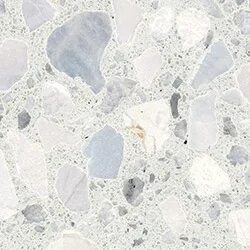
 Terrazzo is perhaps the oldest environmentally friendly flooring product in history, estimated to have been found in Venice, Italy, in the 16th century. Italian builders were looking for a solution to use the granite, marble and stone pieces that were poured in their construction. The best method they found was to get a decorative surface by throwing these materials into the cement mortar, and this method has been used for hundreds of years. The biggest support for terrazzo, which became easier to apply especially with the emergence of electrical appliances at the beginning of the 20th century, was the scientific and technical developments experienced during the Second World War. In this direction, epoxy resins with strong binding and high chemical resistance have started to be used in terrazzo applications.
Today’s terrazzo can reflect architects’ designs on floors with much more vibrant colors than those used in the past, and with its long life and low maintenance cost, it provides an operational advantage over other floor covering materials. It also gives designers the freedom to create eye-catching colors and stunning patterns. This feature is unique to epoxy terrazzo and makes it possible to apply any design you can imagine with correctly selected color-aggregate combinations.
Since no joint is used in the floor covering process, it provides integrity in the areas where it is applied. For this reason, it is preferred in places such as airports, hospitals and shopping centers where flat and wide areas are sought, while adding width to small areas thanks to its continuous structure. Terrazzo flooring, which is widely preferred especially in America and Europe, is not well known in our country. On the basis of this lies the fact that the architects do not know the material well enough, the application stage requires meticulousness and the high production costs are perceived. The perception of high cost does not reflect the reality when considering the life and maintenance of the material.
Recommended article, wooden parquet flooring cost click here to get detailed information about it.
In addition to these advantages of Terrazzo in design, it is also sensitive to the environment in terms of the chemicals it contains. While many chemical materials we use even in our homes contain Volatile Organic Compounds (VOC), which can evaporate even at room temperature, the chemicals that make up the Terrazzo flooring application do not contain any volatile. It is quite healthy as it prevents bacterial and fungal-derived microbiological formations. Terrazzo products, which have been made compulsory to be used in hospitals around the world, protect public health by playing a preventive role in the spread of epidemics (swine flu, mad cow disease, flu, etc.) that have seriously affected societies in recent years.
In addition to all these, the long life of epoxy terrazzo minimizes the energy and resources to be spent for change, thus providing high savings. Today, terrazzo can add about 5 points to a building’s compliance level with LEED directives. In this way, it provides an advantage in the creation of green structures.
How is Terrazzo Applied?
Prerequisites to be Provided
The requirement for good environmental condition is an often overlooked step in any resin flooring application on concrete floors. These conditions are related to moisture or moisture movement, temperature and humidity in the building.
For best results, the floor temperature should be at least 13?C (preferably 15?C) at the time of application. In addition, the condensation point of the epoxy is a very important test parameter to be considered. In all cases, it is recommended that the surface temperature be 5°C above the dew point.
If the surface temperature of the concrete floor is lower than the dew point, moisture condenses on the surface and in some cases is absorbed into the concrete slab. If this happens during application or within 72 hours after application, the reaction of the systems will be interrupted, resulting in a dull appearance and poor adhesion. The most effective way to provide suitable conditions in order to avoid negative consequences is to carry out the flooring process after bringing the building to the ‘usage temperature and humidity conditions’. Continuous air movement and good ventilation also minimize possible condensation in questionable conditions.
Preparation
Improper surface preparation can turn a seemingly simple process into a long and difficult repair process. The following conditions determine the type of surface preparation:
Mechanical Preparation
All dust, contamination and other foreign material must be removed mechanically to ensure satisfactory adhesion. The balling and grinding method using Claw Scraping Diamonds is the most effective method of preparing existing concrete.
Old Concrete
Old concrete surfaces must be structurally sound. Defective areas must be repaired before proceeding with the resin flooring application. Existing paints, shell and loose concrete should be removed by rough blasting, blasting, ball blasting or grinding using Nail Scraping Diamonds. In some cases where building conditions permit, a scraper can also be used to remove excess paint and sealant residues.
New Concrete
New concrete should be treated and dried before paving. New concrete should be kept for a minimum of 28 days. No maintenance aids or sealants should be used before coating, the concrete surface should be smoothed with a steel trowel. Oil, grease, concrete cream or other foreign material must be removed. For this, steam cleaning can be done using a heavy-duty degreaser such as trisodium phosphate. Concrete cream and other foreign materials can be removed by mechanical methods such as vacuum scraping, scraping or grinding. New concrete must be prepared mechanically by blasting, blasting or grinding using Nail Removal Diamonds to ensure a solid adhesion.
Before starting the application, the surface should be checked for moisture. Moisture vapor transport test should be performed using an in situ probe.
Design
Aluminum or brass L-profile strips are used to apply the designs to the floor covering. These strips are bent into shapes suitable for the design and mounted on the ground with the help of a topography. The strips must have a minimum wall thickness of 3mm in terms of resistance to mechanical stress. Epoxy Terrazzo is a liquid product with different viscosity properties. Since it does not have a jointed structure, it provides integrity in the areas where it is applied. While it is preferred especially in places such as airports, hospitals and shopping centers where flat and wide areas are sought, it adds width to small areas thanks to its continuous structure.
After the terrazzo application is made, it is expected to dry for 24-72 hours depending on the weather conditions. After checking that the product is dry, the application teams shave 1.5-2 mm from the floor with the wiping machines. Then, fine grinding is performed with different cutting diamond bits. In this wiping, the final appearance is obtained by shaving approximately 0.5mm. This application is applied wet. For this reason, industrial type vacuum cleaners are used during this application and water leakage is minimized. After shaving and wiping, polisher is applied on the floor. It makes the design look much more beautiful and lively. When terrazzo first appeared, goat’s milk was used for this process. Today, this process can be done more easily with the developing technology and chemicals.
Care and Protection
Soils are the most important elements in every building. Thousands of people and tons of cargo pass over them. At this point, Terrazzo’s difference from alternative floor coverings emerges.
After the epoxy terrazzo application, the first maintenance is done by the application team before the project is delivered. The polished floor attains its final shine by running water over it.
After receiving the floor, the only thing you need to do is to dust the floor with a mop in order to maintain the brightness. Annual maintenance is carried out by the application teams in order to ensure the longevity of your designs. At this stage, after the floor is dusted with a mop, it is polished again to achieve the brightness of the first day.
 Flooring Systems